
What Psychoeducational Assessments Are – and What Parents Should Know Before Starting


Introduction: Why This Topic Matters
If you’re reading this, there’s a good chance your child is being assessed—or someone has suggested that they should be.
For many parents, psychoeducational assessment can feel overwhelming. Reports are long. Scores are unfamiliar. And the stakes feel high, especially when services, supports, or school placement may be affected.
This post is meant to slow things down and start at the beginning.
Psychoeducational Assessment Is Not a Perfect Science

Psychoeducational assessments use some of the best tools we currently have to understand how a student’s brain works, how they process information, and how they learn academically.
That said, assessment is not a perfect snapshot of a child.
On any given day, performance can be influenced by:
Fatigue
Anxiety
Motivation
Rapport with the assessor
Stress, illness, or emotional factors
A student may perform differently across testing days—or even across tasks on the same day. Because of this, high-quality assessment relies on more than just test scores. It requires professional judgment, observation, pattern analysis, and context.
"Scores tell part of the story. They are not the story."
The Role of the Assessor Matters
A strong assessment is not about administering tests as quickly as possible. It’s about being sensitive to whether the evaluator is seeing a student’s true level of functioning.
Assessors are constantly asking:
Is this score representative?
Is anxiety interfering?
Is this pattern consistent across measures?
Does this align with what parents and teachers see?
Assessment is an interpretive process—not a mechanical one.
A Quick Legal Disclaimer (Important)
This article provides general educational information and is not legal advice.
Education systems operate under both federal and state law.
Most school-based psychoeducational assessments are guided by federal law (such as IDEA) and state-specific education codes. On this website, many examples will reference California education law, which may differ slightly from other states.
While there is overlap across states, procedures and eligibility rules are not always identical.
Disability Categories vs. Diagnoses: A Key Distinction
One of the most common sources of confusion for parents is the difference between school eligibility and medical diagnosis.
Federal law identifies 13 disability categories. California also recognizes established medical disability as an additional eligibility category for children ages three through five.
School-based evaluations:
Determine special education eligibility and educational need
Consider whether a disability affects a student’s educational performance
Operate within federal and state education law
Clinical diagnosis and school eligibility are different determinations. A child may meet the criteria for a clinical diagnosis without qualifying for special education. A child may also qualify for educational services under a category that does not match the terminology used in a medical diagnosis.
In California, Licensed Educational Psychologists may diagnose psychological disorders related to academic learning processes when doing so falls within their professional scope of practice.
This difference can be frustrating, especially when:
A child meets clinical criteria but not school eligibility
Language used by schools doesn’t match medical terminology
Understanding this distinction helps set realistic expectations and reduces unnecessary stress.
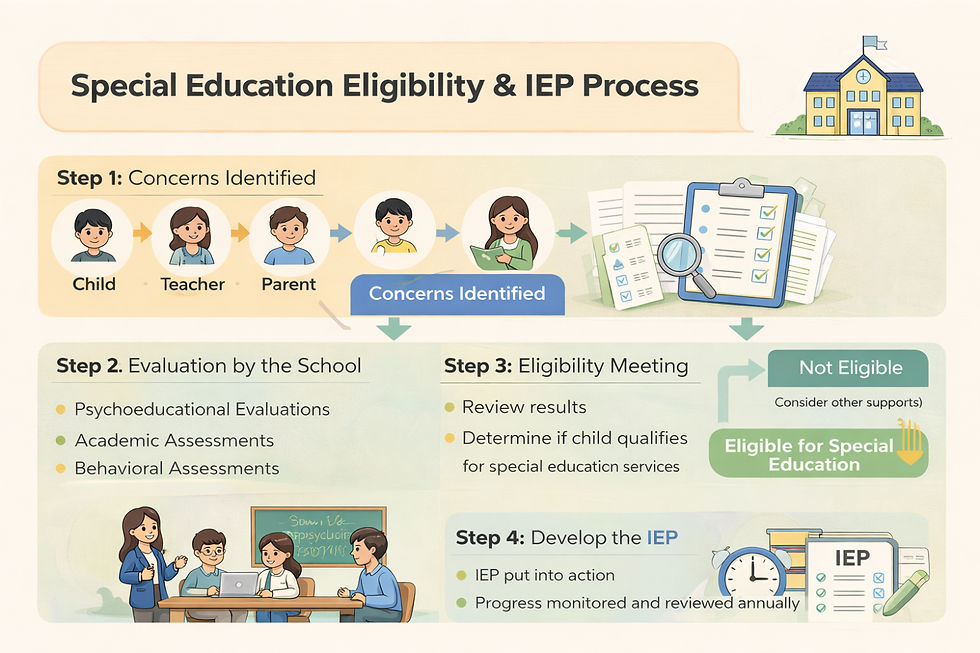
Who Conducts School-Based Assessments?
In the school system, assessments are often completed by a team, which may include:
School psychologists
Speech-language pathologists
Occupational therapists
Special education teachers
Sometimes, professionals use the same assessment tools for different purposes. This overlap is intentional and tied to how eligibility categories are evaluated.
A Note for Private School Parents
In most cases:
The school district where the private school is located is responsible for child-find activities, including identifying and evaluating students who may have disabilities
An evaluation can determine whether a child meets special education eligibility criteria
A child enrolled by their parents in private school does not have an individual right to all the services they would receive in public school
If the district designates the child to receive services, those services are documented in a services plan rather than an IEP
The details can vary depending on the child’s circumstances, the school, and the responsible district.
Understanding Test Scores (Without Getting Lost)
Assessment reports often include:
Standard scores
Scaled scores
Percentile ranks
Descriptive classifications (e.g., average, below average)
While all of these provide information, standard scores are often the most helpful starting point because they are more consistent across tests.
Labels and percentiles can be confusing and sometimes misleading. Numbers should always be interpreted within the broader context of the student—not in isolation.

Looking Ahead
This post is meant to provide a foundation—not answers to every question.
Psychoeducational assessment is a large topic, and trying to understand everything at once can be overwhelming. Future posts will break this process into clear, manageable pieces so parents can build understanding over time.
What’s Coming Next
In an upcoming post, we’ll explore one of the most misunderstood topics in special education:
School Eligibility vs. Medical Diagnosis — Why They’re Not the Same Thing



Comments